What does it take to turn complex research into tools that actually support decisions on water and agriculture?
How do models, data, and digital systems hold up when they meet real operational and policy constraints?
These questions shaped the 5th FARMWISE General Assembly, held in Bologna, Italy, on 28–29 January 2026, where project partners, researchers, innovators, and external stakeholders came together to exchange ideas, challenge assumptions, build connections, and generate momentum for the next phase of the project.
Hosted by the University of Bologna, the meeting was energetic, collaborative, and forward-looking. With FARMWISE moving into its final phases half, discussions focused less on isolated activities and more on how the pieces fit together, how progress can be accelerated, and how results can move closer to real-world use.
“Coming together in Bologna has been really valuable for the project. It’s given us the space for open dialogue about what’s working, where we need to adjust, and how the different parts of FARMWISE connect. Those conversations are essential as we move into the next phase.”
— Sebastian Puculek, Project Coordinator, Lund University
Taking Stock Together: What Is Working, What Needs Attention, and What Comes Next
Rather than offering a series of status updates in isolation, the Status of the Project session was designed as a collective stocktake. Where are we on track? Where are the pressure points? And where do dependencies between Work Packages require closer coordination?
Each Work Package contributed a concise, analytical update, focusing on gaps, risks, interdependencies, and next steps:
- WP1 (UPV) reflected on the evolution of stakeholder networks, scenario preparation, and upcoming capacity-building activities, highlighting their importance for both modelling work and future uptake.
- WP2 (UPWr) reported on the state of data consolidation, including scenario definitions and the development of interactive maps that underpin the FARMWISE decision-support framework.
- WP3 (UNIBO) presented results from innovative solution testing and field activities, alongside ongoing work on performance and scalability assessment. Discussion centred on how these results need to feed into other WPs, particularly WP2 and WP5, to support realistic integration and scaling across European agricultural contexts.
- WP4 (WU) shared outcomes from extreme weather analyses, outlining emerging strategies and highlighting key links with WP2 and WP5 around scenario alignment and risk assessment.
- WP5 (Lund University and H-DA) updated partners on progress with the visual Decision Support System (vDSS), including the integration of AI, visual analytics, and management scenarios.
- WP6 (SITES) outlined ongoing and planned activities for communication, stakeholder engagement, and uptake, ensuring that FARMWISE outputs are positioned for use beyond the project itself.
Taken together, these discussions helped create a shared picture of how individual activities align to form an evolving integrated framework, and where coordination will be most critical in the months ahead.
Moving Beyond Development: Exploring Use, Uptake, and Integration
Alongside the analytical sessions, the General Assembly created space for practical reflection and open discussion on what comes after technical development.
An innovation and exploitation workshop invited partners to step back from technical detail and consider emerging results from across the Work Packages. The aim was not to finalise exploitation strategies, but to start asking practical questions. Who could use these outputs? In what contexts? And what needs to be in place for uptake to be realistic?

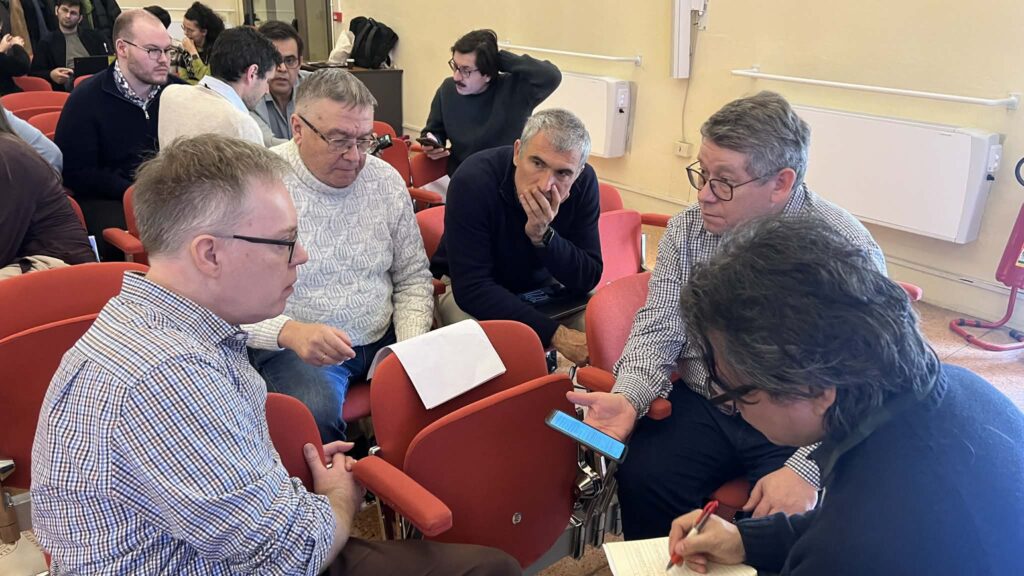
Image: Groups explore the exploitation potential of their results and innovations
The conversation reinforced a clear message heard throughout the meeting: technical performance alone is not enough. For FARMWISE innovations to have impact, they must be relevant to users, scalable across contexts, and compatible with existing practices and decision-making processes.

Image: Group spokespersons present the exploitation potential of their selected results and innovations
Exploring the vDSS in Practice
These questions came into sharper focus during the hands-on demonstration of the FARMWISE visual Decision Support System (vDSS), led by Lund University and H-DA.
In place of a conventional presentation, partners worked in small groups, exploring the latest vDSS prototype using predefined tasks and scenarios. This format enabled observations and user feedback regarding usability, interpretation, and practical application.
- What information is immediately clear?
- Where do users need more context?
- And how can AI-driven insights be presented in ways that genuinely support decisions?

Image: Test-driving the VDSS
The feedback from this session will directly inform the next stages of system development, reinforcing the project’s commitment to user-centred accessible design and iterative improvement.
Why Stakeholders Matter: Insights from Day 2
If FARMWISE is to support better decisions, whose decisions does it need to support?
The morning programme of Day 2 placed this question front and centre, bringing stakeholder perspectives directly into the General Assembly.
The session opened with reflections on water management and AI implementation in the Italian context, shared by Francesco Vincenzi, President of ANBI, and Raffaella Zucaro, Director General of Consorzio CER. Their contributions grounded the discussion in institutional and operational realities, highlighting the importance of tools that work within existing governance structures.


Image: External stakeholders’ presentations
This was followed by a dedicated stakeholder engagement session that brought together complementary perspectives:
Marina Baldini (Romagna Reclamation Consortia) spoke about water quality management from an operational perspective, drawing on experience from regional water systems.
Annalisa Saccardo (Coldiretti Emilia-Romagna) addressed bioeconomy and climate change challenges in agriculture, reflecting on feasibility, risk, and adoption at farm level.
Tonino Liserra (ANBI Emilia-Romagna) explored the role of big data and AI in water governance, focusing on what decision-makers need from digital tools and where complexity can become a barrier.
Together, these voices shifted the discussion from what FARMWISE can deliver in theory to what it needs to deliver in practice. They provided a clear reminder that credibility, usability, and trust are just as important as technical sophistication.
Looking Ahead
The Bologna General Assembly was not about closing conversations, but about opening the right ones at the right time.
Across both days, discussions fed directly into planning for the next project phase, including:
- deeper integration of innovation results across Work Packages
- refinement of data and modelling approaches
- preparation for exploitation and uptake activities
- continued engagement with external stakeholders and potential advisory structures
“FARMWISE was designed with real-world use in mind from the start. What meetings like this add is the chance to test our assumptions, hear directly from stakeholders, and make sure the tools and models we are developing stay aligned with how decisions are actually made.”
— Sebastian Puculek, Project Coordinator, Lund University
As FARMWISE moves forward, the challenge is clear. The project must continue to connect research, technology, and stakeholder realities, ensuring that its tools and approaches respond to the questions water managers, policymakers, and agricultural actors are already asking.
From Discussion to Practice: The Field Visit
Following the General Assembly, partners visited the Italian case study sites, offering an opportunity to see how many of the issues discussed in Bologna play out in practice. The visit allowed participants to observe water management systems in operation and to ground FARMWISE discussions in real landscapes, infrastructure, and decision-making contexts.
A dedicated article on the field visit, including highlights and reflections, can be found HERE
You May Also Like
Water, Soil and the Future o ...
17/02/2026
FARMWISE at HortiFruit: Turn ...
05/02/2026
From Orchard Row to the Rive ...
05/02/2026