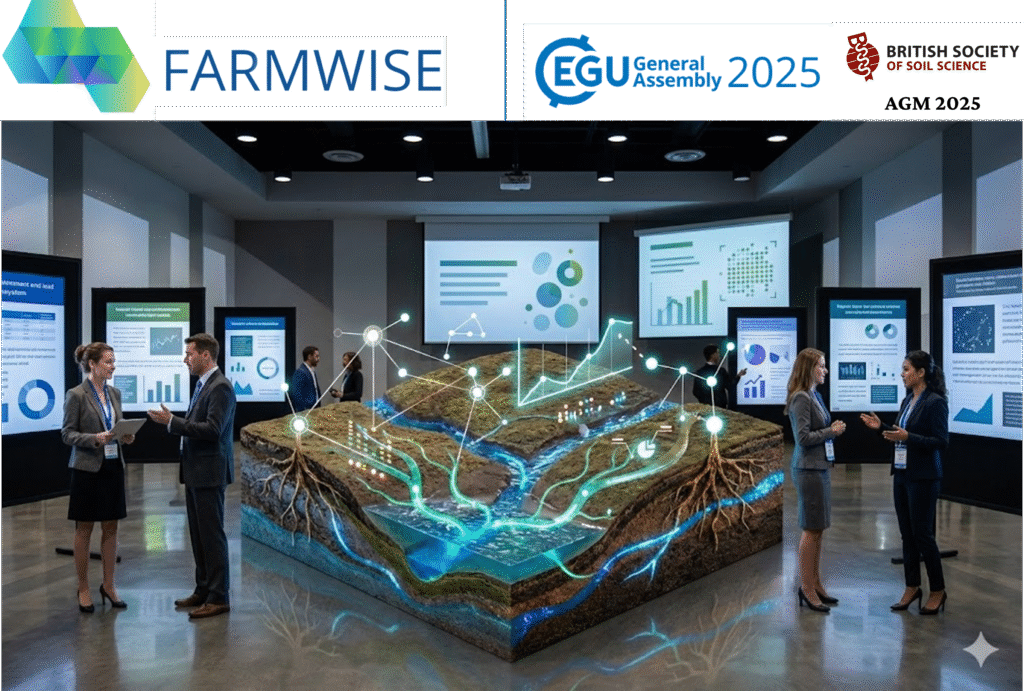
FARMWISE researchers have recently presented new results at two major international scientific meetings, using poster sessions to share early findings, exchange ideas with peers, and strengthen the project’s visibility within the wider soil, water, and agricultural research communities. Together, these contributions highlight how FARMWISE is advancing evidence-based approaches to nutrient management, soil protection, and climate-resilient farming.
Understanding the future costs of soil compaction in Europe
British Society of Soil Science Annual General Meeting, Manchester (3–5 December)
At the Annual General Meeting of the British Society of Soil Science, Dr Alejandro Romero-Ruiz from the University of Neuchâtel presented a poster entitled Compaction-induced losses in soil services in Europe under future climate, examining how soil compaction could undermine key soil services across Europe under future climate conditions.
Using advanced modelling that combines soil processes with climate projections, the work explored how compaction affects crop yields, carbon storage, nitrogen cycling, and associated economic losses. Rather than focusing on individual fields, the study looked at continental-scale patterns, helping to identify where impacts may be most severe and how they could evolve over time.
By presenting these results to soil scientists, policymakers, and practitioners, the poster stimulated discussion on why soil compaction remains an under-recognised risk and how better management strategies are needed to protect both productivity and environmental performance. The exchange helped position FARMWISE as a project contributing robust, forward-looking evidence to debates on sustainable soil management.
Optimising fertilisation to reduce nitrate leaching
EGU General Assembly 2025, Vienna (27 April – 2 May)
At the European Geosciences Union General Assembly in Vienna, Dr Alejandro Romero-Ruiz and Dr Landon Halloran from the University of Neuchâtel presented a poster on how fertilisation rates influence nitrate leaching in agricultural soils.
The work showed how process-based modelling can be used to explore trade-offs between maximising crop yields and minimising nitrogen losses to groundwater. By simulating different fertilisation levels across varying soil types, the researchers demonstrated that “more fertiliser” does not always mean “better outcomes,” and that optimal application rates depend strongly on local conditions.
Engaging with a diverse EGU audience allowed the authors to explain how FARMWISE integrates modelling, monitoring, and decision-support tools into a single framework. Discussions with other researchers and practitioners helped validate the relevance of this approach and reinforced the project’s role in supporting smarter, site-specific nutrient management under climate change.
Managing water more effectively through controlled drainage and subirrigation
EGU General Assembly 2025, Vienna (27 April – 2 May)
A second FARMWISE-related poster at EGU 2025 was presented by Jelte de Bruin, Martine van der Ploeg, Janou Bonné, and Syed Mustafa from Wageningen University, together with Nikola Rakonjac, Ruud Bartholomeus, and Janine de Wit from KWR Water Research Institute.
Their work focused on a field-scale system combining controlled drainage with subirrigation, designed to give farmers greater control over water availability during both droughts and wet periods. Using detailed hydrological modelling supported by field measurements in the Netherlands, the study explored how irrigation water is distributed within the soil system and where potential losses occur.
By sharing early results at EGU, the team received valuable feedback on modelling approaches and data interpretation, while also demonstrating how FARMWISE evaluates practical water-management solutions under real farming conditions. The poster helped bridge the gap between experimental research and on-farm decision-making, reinforcing the project’s emphasis on actionable, climate-resilient strategies.
You May Also Like
Water, Soil and the Future o ...
17/02/2026
FARMWISE at HortiFruit: Turn ...
05/02/2026
FARMWISE in Bologna: From Pr ...
05/02/2026