This article is co-authored with Frauke Seebass, Member, Balkans in Europe Policy Advisory Group (BiEPAG).
The EU has a strategic opportunity to bring the Western Balkans closer to the Single Market. But it risks losing influence if its enlargement promises are not followed by concrete steps. As China expands its economic presence, particularly in Serbia, the October European Council summit should offer candidate countries a clearer route towards integration, with credible timelines and benefits they can see before accession.
The European Commission’s pre-enlargement policy reviews, presented on 6 October, seek to prepare both the EU and candidate countries for possible accessions in the coming years, including Montenegro, Albania, Moldova and Ukraine. One proposal is gradual integration into the Single Market: opening parts of the EU economy to candidates as they undertake reforms, rather than making them wait until membership.
This approach builds on the EU’s greatest advantage: the size of its market and the depth of its economic ties. The reviews also introduce a more explicit geopolitical condition, calling for alignment with EU foreign-policy objectives. The concern is that strategic competitors could exploit links with candidate countries to gain access to sensitive technologies or information.
The summit should turn these ideas into a comprehensive offer for the Western Balkans. That means moving beyond isolated sectoral initiatives to clear roadmaps, realistic timelines and tangible rewards for reform. Without a more credible process, the EU risks allowing its competitors to shape the region’s economic and political future.
The EU Leads Economically, but Competitors Are Gaining Ground
Enlargement is no longer only about extending EU rules and institutions. It is also about protecting Europe’s economic interests and political influence. A recent study by ECIPE and the Balkans in Europe Policy Advisory Group (BiEPAG) shows how geoeconomic competition has become an increasingly important factor in the Western Balkans. The EU’s enlargement strategy needs to reflect that change.
China, Russia, Türkiye and Gulf countries are seeking influence through investment, trade, political relationships and cultural ties. Weak governance and local political interests can make it easier for outside actors to gain a foothold. The EU remains the region’s dominant economic partner, but slow progress on enlargement and inconsistent political engagement have left openings for others.
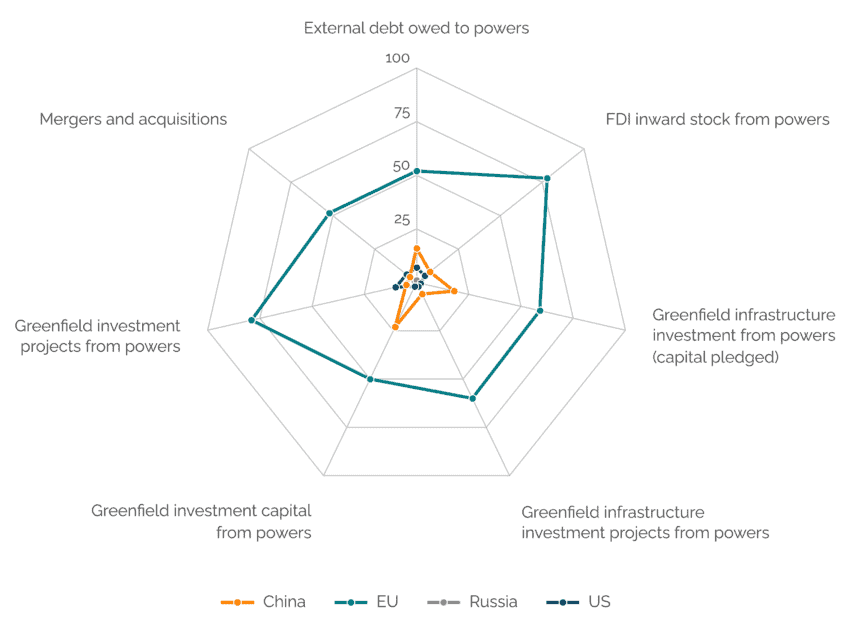
The Geoeconomic Interconnectivity Index (GEOII), which measures the relative strength of trade, financial and policy links between the EU, competing powers and neighbouring countries, illustrates this tension. Figure 1 shows that the EU continues to lead in financial connections with the Western Balkans in 2023. Russia and the United States have a relatively limited presence across the indicators shown, while China has become a more significant competitor.
Figure: Financial Connections with the Western Balkans, by External Power (2023) Source: GEOII. The index ranges from 0 (least interconnected) to 100 (most interconnected). See https://geoii.eu/start.
China presents a particularly complex long-term challenge. Its investment activities are closely linked to wider strategic interests, while the EU must also manage its own economic relationship with Beijing. China’s role in Russia’s war against Ukraine and its rivalry with the United States add to the geopolitical stakes.
Chinese companies can compete strongly for public contracts, supported in some cases by state financing and differences in labour and environmental standards. Investment can bring needed infrastructure and capital, but projects that lack transparency or weaken regulatory standards can also make alignment with EU rules more difficult. Such dependencies may persist even after accession.
Serbia Shows Where the Competition Is Most Intense
China’s growing influence is not evenly distributed across the Western Balkans. It is particularly pronounced in Serbia, a major destination for projects associated with the Belt and Road Initiative. Belgrade has sought to benefit from relationships with both the EU and the United States and with non-Western powers. It also maintains close ties with Russia, including through political, media and religious networks, while its strategic partnership with China includes a free trade agreement.
Chinese involvement spans transport infrastructure, heavy industry, mining, technology and energy, often supported by loans from Chinese state banks. These activities increasingly touch sectors of particular strategic importance to the EU: energy, security, digital connectivity and critical raw materials.
The GEOII figures highlight the scale of the shift. Between 2013 and 2023, the EU’s score for greenfield investment capital in Serbia fell by 34 index points, while China’s rose by 61. For pledged capital in greenfield infrastructure projects, the EU fell by 50 points and China gained 45. These are changes in index scores, not percentage changes in investment volumes. They nevertheless point to a substantial shift in relative financial engagement.
Table: Change in Financial Engagement with Serbia, 2013–2023 (GEOII Index Points) Source: GEOII.
Other powers also matter, though their roles differ. Russia’s direct economic footprint has diminished over the past decade, but Moscow continues to seek influence through disinformation, religious connections and political networks. Investments from the United Arab Emirates in Serbia, Albania and Montenegro have drawn criticism over limited public scrutiny. Questions have also been raised about proposed US-linked investments, including gas infrastructure in Bosnia and Herzegovina, and their compatibility with EU reform priorities.
Türkiye’s growing presence is generally more compatible with the EU’s objectives, given its NATO membership and formal EU candidate status. Yet closer economic ties can also create dependencies, and democratic backsliding in Türkiye raises questions about the longer-term implications for governance in the region.
A Credible Enlargement Offer Is the EU’s Strongest Asset
The EU still has more economic leverage in the Western Balkans than any of its competitors. Access to the Single Market is a powerful incentive for reform. But that leverage depends on whether candidate countries believe the EU will deliver what it promises.
The Commission has previously presented closer Single Market integration as a central part of its Growth Plan for the Western Balkans. Progress has not yet matched the ambition of that promise. Further announcements without practical follow-through would only deepen doubts about the enlargement process.
There is now political momentum behind faster integration in selected sectors. The Commission and member states should use it to build a coherent framework rather than a collection of disconnected initiatives. Candidate countries need to know which reforms will unlock which benefits, when participation in EU programmes and institutions could begin, and how gradual integration will lead towards eventual membership. Observer participation could provide an early step in appropriate areas.
This approach must also account for differences in readiness across the region. Benefits should reward progress without creating permanent divisions between candidate countries. Equally, deeper access should go hand in hand with stronger alignment on EU rules and foreign-policy priorities, particularly in sensitive sectors.
The October summit should therefore deliver a political commitment backed by member states, with clear milestones and visible economic gains. A credible path to integration would strengthen reform incentives, limit the room for strategic competitors to exploit uncertainty and help protect the integrity of the Single Market. Enlargement is not simply a concession to the EU’s neighbours. Done well, it is an investment in Europe’s own economic security and geopolitical influence.
Author: European Centre for International Political Economy (ECIPE) (Source: https://ecipe.org/insights/make-enlargement-more-credible/)