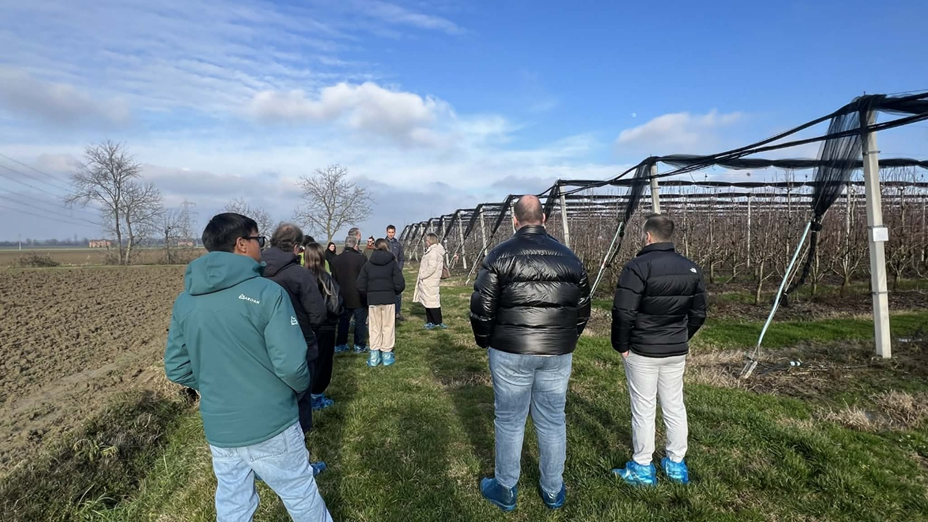
As part of the FARMWISE General Assembly held at the University of Bologna from 28th – 29th January, project partners took part in a field visit that brought the project’s systems-thinking approach to life. From experimental orchards and precision irrigation trials at Acqua Campus to the large-scale water infrastructure managed by Canale Emiliano Romagnolo (CER), participants were able to trace the full pathway to farm-level decision-making. from actual river basin management.
Organised by Consorzio di Bonifica per il Canale Emiliano Romagnolo (CER), the site visits illustrated how FARMWISE connects data, soil, water, infrastructure and governance into a coherent framework for more resilient agriculture.
Innovation tested where farming happens
Acqua Campus functions as a living laboratory, where irrigation strategies, soil amendments and decision-support tools are tested under real farming conditions rather than in controlled experimental settings. Located on a floodplain shaped by centuries of alluvial deposition, the site is characterised by deep soils exceeding three metres, alternating layers of sand and clay, and a shallow water table. These conditions make it particularly well suited to both intensive cropping and orchard systems.
Depending on the season, fields and orchards at Acqua Campus include maize, soybean and processing tomatoes, alongside fruit crops such as kiwi, cherries and peaches. This diversity provides an ideal setting to study how soil properties, water availability and crop responses interact under Mediterranean climate pressures and ways of adapting to effects of climate change.
Within FARMWISE, Acqua Campus serves as the Italian case study and living lab, offering a place where models, sensors and decision-support systems can be tested against real-world variability.
Biochar in orchards: evidence before assumptions


A central focus of the visit was an ongoing biochar field trial in a Fuji apple / William pear orchard, carried out jointly by Acqua Campus and the University of Environmental and Life Sciences in Wrocław (UPWr).
The trial explores whether biochar, a carbon-rich material derived from residual plant biomass, can improve soil structure, water-holding capacity, nutrient dynamics and overall orchard performance. Biochar was incorporated along orchard rows, followed by systematic soil sampling, on-site measurements of soil moisture and physical properties, and an experimental harvest designed to assess effects on yield and fruit quality.

Soil samples have been transferred to UPWr’s laboratories in Poland for detailed physico-chemical analysis. By linking laboratory data with field observations, the FARMWISE team is building a robust evidence base on how biochar behaves in orchard systems over time.
Precision irrigation and smarter restraint
Participants also observed how decision-support systems guide irrigation management at field scale. Using sensors, biomass mapping and water-balance modelling, Acqua Campus applies data-driven strategies that determine when irrigation is needed and how much water should be applied.
Field data are transmitted to a central control unit that adjusts irrigation volumes accordingly. In one example discussed during the visit, a maize field showed clear spatial differences in crop development. Rather than compensating weaker areas with additional water, irrigation was limited to zones where plants could make effective use of it.
This practical demonstration highlighted a core FARMWISE principle: water efficiency is not about applying more water, but about making better decisions.
Water as protection against climate extremes
Water management at Acqua Campus is also used as a tool for climate resilience, particularly through anti-frost irrigation systems in orchards. During frost events, water is sprayed onto flowering trees. As the water freezes, it releases latent heat, protecting delicate blossoms from damage.
Participants learned that even light frost can destroy an entire orchard yield, which explains why this technique is now used across more than 1,000 hectares in the region.
From field trials to regional water governance
The subsequent visit to CER placed these field-scale innovations in their wider operational context. CER manages a vast canal system that transfers water from the River Po across the Emilia-Romagna region, supplying irrigation while also playing a critical role in flood prevention.
Each year, millions of cubic meters of water are diverted from the river into the canal system. Flow is actively managed using pump stations, dams and control structures that regulate both direction and volume depending on river levels and seasonal conditions. Sediment is regularly removed from the canal bed to maintain efficiency and protect infrastructure.


Images: The Pump Station controls
The visit highlighted how the irrigation season has lengthened significantly in recent years and now extends for around nine months, reflecting changing climate conditions and crop needs. Operating this system requires substantial energy input, with annual energy costs in the order of several million euros.
Water quality was also a key theme. The River Po flows through one of Europe’s most environmentally pressured river basins, collecting industrial and agricultural runoff along its course.

Image: The Station Manager describes the route of the river and the canal, and their vital purpose
Within parts of the CER canal system, wider cross-sections and slower flow allow vegetation to develop, contributing to a natural reduction in nutrient loads before water is distributed for irrigation.
Why these visits matter for FARMWISE
Together, the visits to Acqua Campus and CER illustrated how farm-level decisions are shaped by infrastructure, energy use, seasonal pressures and catchment-scale water governance. They showed that effective decision-support tools must be grounded not only in field data, but also in an understanding of how water is managed upstream.
For FARMWISE, this systems perspective is essential. The Italian case study demonstrates how innovation, evidence and governance must work together to support more resilient, water-smart agriculture across Europe.

Image: Post visit food at La Bottega del Cinema di Michele Sartini https://www.labottegadelcinema.it/
More info:
You May Also Like
New study reveals hidden eco ...
29/06/2026
Policy and practice watch:
28/05/2026
From nitrate hotspots to har ...
27/05/2026